
The DFCT regulations were first established when the organization was founded, and have since been revised as needed. The “DFCT Regulations (Revised B.E. 2534)” were announced on 16 August 1991. In 1992 (B.E. 2535) these were revised to add the DFCT emblem, still in use today, and to establish network offices at the various dental faculties for more effective coordination, becoming the “DFCT Regulations B.E. 2536 (1993),” announced 5 March 1993. As more dental faculties were established and the DFCT assembly grew larger, the Consortium invited representatives of the planned Faculty of Dentistry, Srinakharinwirot University, to join meetings in September 1993, and representatives of the planned Faculty of Dentistry, Thammasat University, in April 1994; once formally established, both faculties became full DFCT board members.
In 1995 (B.E. 2538), the 1993 regulations were revised following the enactment of the Dental Profession Act B.E. 2537 (1994), which created the Dental Council of Thailand, and following the establishment of several new dental faculties, requiring DFCT to restructure for greater flexibility. This became the “DFCT Regulations B.E. 2538 (1995),” effective from 15 October 1995.
In 2007 (B.E. 2550), the 1995 regulations were comprehensively revised into the “DFCT Regulations B.E. 2550 (2007),” effective from 5 November 2007.
Following changes to subcommittee terms (extended to 3 years) and new provisions on organising meetings and domestic/international travel to meetings, the regulations were revised once more into the “DFCT Regulations B.E. 2560 (2017),” effective from 6 October 2017 and remaining in force today.
DFCT Regulations
B.E. 2560 (2017)
Chapter 1
General Provisions
Article 1. “Regulations” means the DFCT Regulations B.E. 2560 (2017).
Article 2. This organization is called the “Dental Faculty Consortium of Thailand” (DFCT), English name “Dental Faculty Consortium of Thailand” (D.F.C.T).
Article 3. These regulations take effect from the day following their announcement.
Article 4. The DFCT Regulations (Revised B.E. 2538) are hereby repealed and replaced by these regulations.
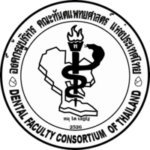
Article 5. The DFCT emblem consists of a map of Thailand overlaid with a snake coiled around a torch base bearing the Thai letter “ท,” with the words “Tanto Settho 2526” beneath. The whole image is bordered by two concentric circles; the upper half between the borders reads “Dental Faculty Consortium of Thailand” in Thai, and the lower half reads “Dental Faculty Consortium of Thailand (D.F.C.T)” in English, separated by a lotus flower symbol representing the Suttha Sinobol lotus.
Article 6. The Secretariat Office is located at the faculty of dentistry to which the DFCT Secretary-General belongs.
Article 7. In these regulations:
“Faculty” means a faculty of dentistry that is a government or state agency in Thailand.
“Profession” means the dental profession.
“Dean” means the dean of a faculty of dentistry.
“The Consortium” means the Dental Faculty Consortium of Thailand.
“Chairman of the Consortium” means the Chairman of the Dental Faculty Consortium of Thailand.
“The Board” means the Board of Directors of the Dental Faculty Consortium of Thailand.
“Subcommittee” means a standing subcommittee of the Dental Faculty Consortium of Thailand.
“Administrator” means a dean, deputy dean, assistant dean, department head, or member of a faculty’s standing committee.
“Advisory board member” means a person appointed as an advisory member of the Board.
“Secretary-General” means the Secretary-General of the Dental Faculty Consortium of Thailand.
“Deputy Secretary-General” means the Deputy Secretary-General of the Dental Faculty Consortium of Thailand.
“Member” means an administrator, past dean, advisory board member, Secretary-General or Deputy Secretary-General.
Article 8. The Council of Deans is responsible for matters relating to the Consortium’s activities.
Article 9. The Consortium’s income derives from:
(1) Contributions from member faculties
(2) Donations
(3) Other income arising from operations as the Board sees fit, to be governed by financial regulations approved by the Board
Article 10. The Council of Deans shall be the authority responsible for these regulations.
Chapter 2
Objectives
Article 11. The Dental Faculty Consortium of Thailand serves as a central body for the faculties, for the purposes of cooperation, coordination, and carrying out academic and research work, education administration, curricula, teaching and learning, administration and development, and other activities relating to the faculties and the profession.
Chapter 3
Composition
Article 12. The Consortium’s operations comprise:
(1) The Council of Deans
(2) The Board of Directors
(3) The Subcommittees
(4) The Members’ Assembly
Article 13. The Council of Deans comprises the deans of every faculty.
Article 14. The Board of Directors comprises:
(1) Deans of every faculty
(2) One director per faculty, representing faculty administrators
(3) Advisory board members, comprising:
(3.1) The President of the Dental Association of Thailand under Royal Patronage
(3.2) The President of the Dental Council of Thailand
(3.3) The President of the Royal College of Dental Surgeons of Thailand
(3.4) Advisory board members appointed by the Council of Deans, not exceeding half the combined number of directors under 14(1) and 14(2)
(4) The Secretary-General
(5) The Deputy Secretary-General (if any)
Article 15. Subcommittees are divided into standing subcommittees and other subcommittees. There are 3 standing subcommittees:
(1) Subcommittee on Academic Affairs and Dental Research, responsible for:
(1.1) Organising conferences to present academic and dental research work
(1.2) Organising continuing education
(1.3) Coordinating postgraduate curricula
(1.4) Promoting inter-faculty research
(1.5) Other duties assigned by the Council of Deans or the Board
(2) Subcommittee on Curriculum and Dental Education, responsible for:
(2.1) Coordinating undergraduate (DDS) curricula
(2.2) Coordinating academic quality assurance at undergraduate level
(2.3) Other duties assigned by the Council of Deans or the Board
(3) Subcommittee on Administration and Development, responsible for:
(3.1) Coordinating faculty development programmes
(3.2) Coordinating dental-education technology development programmes
(3.3) Coordinating development of fee-collection systems across dental faculties
(3.4) Other duties assigned by the Council of Deans or the Board
15.1 Each subcommittee comprises:
(1) A chairperson appointed by resolution of the Board
(2) One representative per faculty
(3) One representative of the Board
(4) Members or advisors appointed by the subcommittee chair
Article 16. The Members’ Assembly comprises:
(1) Administrators of each faculty
(2) Past deans
(3) Advisory board members
(4) The Secretary-General
(5) The Deputy Secretary-General (if any)
Article 17. The Board may propose to the Council of Deans the appointment of additional advisors, working groups, or subcommittees as necessary.
Chapter 4
Duties and Operations
Article 18. The Chairman of the Consortium shall:
(1) Chair the Council of Deans
(2) Chair the Board of Directors
(3) Chair the Members’ Assembly
(4) Represent the Consortium in signing orders, official correspondence with government departments and above, or other documents, with the approval of the Council of Deans or the Board
Article 19. The Council of Deans shall:
(1) Set policy consistent with the Consortium’s objectives
(2) Consider appointing or removing the Secretary-General and Deputy Secretary-General
(3) Consider appointing advisory board members
(4) Propose the Consortium’s operating plan and budget
(5) Set the annual contribution rate from member faculties (per Article 9(1))
Article 20. The Board of Directors shall:
(1) Propose policy directions on academic affairs, education administration, and other faculty- and profession-related activities
(2) Establish and amend regulations, rules or operating guidelines under these regulations
(3) Review and summarise the work of the subcommittees
(4) Approve the Consortium’s operating plan and budget
(5) Consider recommendations from the Members’ Assembly
(6) Other duties assigned by the Council of Deans
Article 21. Subcommittees shall:
(1) Gather and study information to propose approaches and methods of operation to the Board
(2) Propose ideas of benefit to the faculties and the profession
(3) Carry forward decisions of the Board
(4) Appoint working groups as appropriate
(5) Other duties assigned by the Council of Deans or the Board
Article 22. The Secretary-General shall:
(1) Coordinate and monitor the Consortium’s operations
(2) Represent the Consortium in general affairs
(3) Monitor and analyse external developments affecting the Consortium or the profession
(4) Be responsible for managing meetings, personnel, documents, finance, procurement, premises and assets of the Consortium
(5) Other duties assigned by the Council of Deans or the Board
Article 23. The Deputy Secretary-General shall perform duties as assigned by the Secretary-General.
Article 24. Members have the right and duty to:
(1) Attend meetings and express opinions at the Members’ Assembly
(2) A group of 30 or more members may propose an item for the Board’s consideration
(3) A group of 30 or more members may bring an item onto the agenda of the Members’ Assembly; if approved by a majority of the Assembly, the Board shall act on it
Chapter 5
Selection, Term, and Cessation of Membership
Article 25. Each dean selects the following representatives from their faculty:
(1) Directors under Article 14(2)
(2) Subcommittee members under Article 15.1(2)
Article 26. Each subcommittee proposes names to the Council of Deans for appointment of its working groups.
Article 27. The Board proposes names to the Council of Deans for appointment of:
(1) Subcommittee chairs under Articles 15(1), 15(2) and 15(3)
(2) The Board’s representative under Article 15.1(3)
Article 28. The Council of Deans considers and appoints:
(1) Advisory board members under Article 14(3)
(2) The Secretary-General and Deputy Secretary-General (if any)
(3) Subcommittee chairs under Article 15
Article 29. Terms of the Board:
(1) Directors under Article 14(2) serve terms coinciding with their dean’s term
(2) Directors under Article 14(3) serve 2-year terms and may be reappointed consecutively
(3) Directors under Articles 14(4) and 14(5) serve 2-year terms and may be reappointed for no more than 2 consecutive terms
Article 30. Each subcommittee serves a 3-year term.
Article 31. Membership ends when a member:
(1) Ceases to hold an administrative position (except past deans)
(2) Completes their term
(3) Resigns
(4) Passes away
Chapter 6
Meetings
Article 32. The Council of Deans selects a dean from among the faculties to chair the Board at each meeting on a rotating basis as appropriate.
Article 33. The Council of Deans shall meet at the same time as the Board, with special meetings called as appropriate.
Article 34. The Board shall meet at least once every 3 months.
Article 35. Subcommittees shall meet as needed, with each subcommittee chair reporting progress to the Board at each Board meeting, or directly to the Council of Deans where necessary.
Article 36. The Members’ Assembly shall meet at least once every 2 years, with a quorum requiring attendance by at least half of all deans.
Article 37. A Board meeting requires attendance by at least half of all directors or their representatives, including at least half of all deans, to form a quorum.
Article 38. If the chair of the Board or the Members’ Assembly is absent, the most senior dean present shall chair in their place.
Article 39. Agenda items for Board meetings must be submitted in writing to the Secretary-General at least 10 days before the meeting, except in urgent cases where items may be proposed for inclusion by resolution at the meeting itself.
Article 40. Resolutions require more than half the votes of directors or members present to be considered a resolution of the meeting; the Council of Deans may request reconsideration of a resolution.
Chapter 7
Organising and Travelling to Domestic Meetings
Article 41. DFCT may co-host meetings beyond its regular annual meeting with Board approval, and the Board may approve directors or other suitable persons to attend domestic meetings on topics important to the profession or to dental education.
Article 42. Expenses for organising or attending meetings within or outside the Bangkok metropolitan area are reimbursable for registration fees only, at actual cost.
Chapter 8
Travelling to International Meetings
Article 43. The Board may approve directors or other suitable persons to attend international meetings on topics important to the profession or to dental education.
Article 44. DFCT approves reimbursement of registration fees, travel costs, a combined accommodation-and-per-diem allowance, and related travel expenses, at actual cost but not exceeding government regulations, and not exceeding the following rates:
(1) Laos, Myanmar, Cambodia, Vietnam: 30,000 baht
(2) Southeast Asia: 40,000 baht
(3) Asia and the Middle East (except Japan): 50,000 baht
(4) Australia and New Zealand: 60,000 baht
(5) Europe, the Americas, Africa, and Japan: 70,000 baht
Article 45. Travellers on official international business may depart in advance of their duties as necessary and must return to Thailand promptly after completing their duties, subject to the following limits:
(1) For destinations in Asia: depart no more than one day in advance and return within one day of completing duties
(2) For Australia, New Zealand, Europe, or North America: depart no more than two days in advance and return within two days of completing duties
(3) For South America or Africa: depart no more than three days in advance and return within three days of completing duties
Article 46. Foreign-exchange rate criteria:
(1) The exchange rate on the date of the transaction shall be used, supported by evidence of the exchange or payment
(2) Where no such evidence exists, the Bank of Thailand’s exchange rate one day prior to travel shall be used
Chapter 9
Amendment of Regulations
Article 47. These regulations may be repealed or amended by a resolution of no fewer than two-thirds of the Board, with the approval of the Council of Deans.
Announced on 8 December 2017